
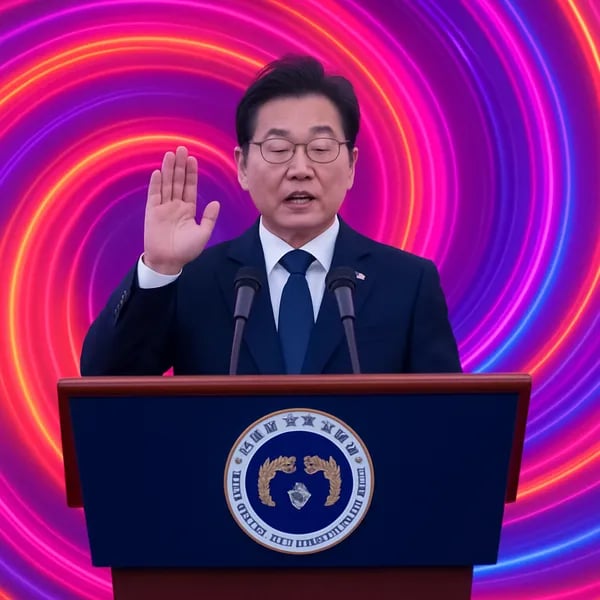


Picture this: You’re a Seoul commuter, watching the city’s skyline flicker awake one early June morning, unaware that you’re witnessing a kind of political sunrise. Lee Jae-myung, once a factory worker at age 14, is being sworn in as president after months of turmoil—his hand raised, the crowd’s breath held, the world’s headlines spinning. Years from now, will you remember his humble beginnings, or the tension that spilled onto Seoul’s streets? Let’s retrace the story that led here, pausing for the moments that felt too wild for any scriptwriter.
Act One: A Presidency Forged in Crisis
You wake up on June 4, 2025, to the sight of Lee Jae-myung standing before the National Assembly , hand on heart, as he is sworn in as South Korea’s new president. The moment feels historic—not just for Lee, but for a nation battered by months of chaos. His journey, from a childhood spent in poverty in Andong’s markets and Seoul’s factories to the Blue House, is now woven into the fabric of South Korea’s political narrative.
Six months earlier, the country was in turmoil. Former President Yoon Suk Yeol’s declaration of martial law in December 2024 sent shockwaves through the streets of Seoul. Protests erupted, with crowds both supporting and opposing Yoon’s People Power Party . The air was thick with anxiety, as the nation’s democracy was tested in ways not seen since the authoritarian crackdowns of the past. The People Power Party’s grip slipped, and the government became a revolving door of interim leaders—each one struggling to steady the ship as the export-driven economy was battered by US President Donald Trump’s global tariffs.
For many, the 2025 presidential election was about more than picking a new leader. It was a referendum on accountability, a demand for political stability after months of uncertainty. On June 3, voters turned out in record numbers—79.38%, the highest since 1997. You might have felt it yourself: a sense of urgency, a need to restore public confidence in the presidency and the institutions that underpin South Korean democracy.
Lee Jae-myung’s victory was decisive. He secured 49.42% of the vote, a remarkable comeback after his narrow 2022 loss to Yoon Suk Yeol by less than one percentage point. The Democratic Party of Korea , Lee’s political home, now holds both the presidency and a strong majority in the National Assembly. This unity could mean a return to “normal politics,” as described by Celeste Arrington, a Korea Foundation associate professor at George Washington University. After months of legislative gridlock and executive drift, the country seems poised for a new chapter.
But the scars of the South Korean political crisis run deep. Martial law left the nation’s economic heart exposed. As Cho Hee-kyoung, a law professor at Hongik University, notes,
“For an export-reliant nation like South Korea, not having a permanent leader to engage with Washington on tariff negotiations was a serious problem.”Trump’s tariffs hit hard, and the lack of steady leadership only heightened the sense of vulnerability. The public’s demand for political accountability was clear, with the record voter turnout serving as a stinging rebuke to the People Power Party and its handling of the crisis.
Lee’s personal story resonates in this moment of upheaval. Born the fifth of seven children, he grew up working-class—his father a market cleaner, his mother a public bathroom fee collector. At 14, Lee was already a factory worker, suffering a permanent arm injury in a baseball glove plant. He envied classmates with enough to eat or proper uniforms. Yet, he persevered, earning a full scholarship to Chung-Ang University and later becoming a human rights lawyer. His rise from poverty to mayor of Seongnam, then governor of Gyeonggi province, and now president, is a testament to grit and resilience.
Yet, Lee’s presidency begins under a cloud of legal uncertainty. He faces ongoing investigations into corruption, abuse of power, and a property development scandal. There is also a conviction for violating election law—currently under appeal. Whether presidential immunity will shield him from prosecution for cases initiated before his term remains unclear. Lee insists these allegations are politically motivated, stating in a December 2024 interview that the charges lack evidence.
The inauguration was a moment of hope. Lee called for “coexistence, reconciliation, and solidarity,” urging the nation to “open an era of national happiness, of dreams and hope.” His message is clear: the wounds of martial law and political crisis must heal. He promises to rebuild what was destroyed, vowing, “An insurrection that uses the military’s power, to seize the people’s sovereignty, must never happen again.”
As you watch Lee Jae-myung take office, the challenges ahead are clear: restoring public confidence, navigating tough trade negotiations with the US, and ensuring political accountability after a period that shook South Korea’s democracy to its core. The world is watching, and so are you.
Act Two: Navigating Legal Shadows and Fractured Loyalties
You watch as Lee Jae-myung, once a factory worker at age 14, now stands at the center of South Korea’s political stage. His inauguration on June 4, 2025, is more than a personal triumph—it’s a turning point for a nation still reeling from months of political crisis and martial law. But as Lee steps into the Blue House , the legal cases and allegations that have dogged him for years refuse to fade into the background.
Legal Cases: A President Under Scrutiny
Lee Jae-myung enters office with a cloud of legal uncertainty overhead. At one point, he faced five ongoing legal cases, ranging from alleged corruption and abuse of power to a conviction for making a false statement during a 2022 election debate—a case now under appeal. The property development scandal and accusations of election law violations have been headline news for months. Despite these challenges, the Constitutional Court cleared Lee to run in late March 2025, a decision that sparked debate about the role of the judiciary and the boundaries of presidential accountability.
The question of presidential immunity looms large. Can lawsuits and investigations from before Lee’s term continue now that he holds the highest office? Legal experts point to a gray area in South Korean law. Some argue that immunity should shield the president from prosecution, while others insist that justice must not be delayed for political leaders. As you follow the news, you sense that this unresolved issue could define Lee’s presidency—and the country’s approach to political accountability.
Martial Law, Impeachment, and the Public’s Demand for Accountability
The backdrop to Lee’s rise is a nation still shaken by the events of December 2024. Former President Yoon Suk Yeol’s declaration of martial law plunged South Korea into chaos, leading to Yoon’s impeachment and a rapid succession of interim leaders. The political crisis exposed deep divisions and eroded public confidence in the government. For many voters, the June 2025 election was a demand for change and a rejection of the People Power Party’s handling of the crisis.
Lee’s own actions during this period became a defining moment. As martial law gripped Seoul, Lee livestreamed himself and fellow lawmakers scaling the National Assembly fence, confronting soldiers, and forcing an emergency vote to end military rule. The footage went viral, watched tens of millions of times. Was it personal courage or political theater? The answer depends on whom you ask. Supporters saw a leader willing to risk everything for democracy; critics questioned his motives and pointed to his unresolved legal cases.
Personal Baggage and Political Theater
Lee’s journey from poverty in Andong to the presidency is well known. His family’s struggles, his permanent arm injury from factory work, and his rise as a human rights lawyer all form part of his public image. Yet, as you listen to inauguration speeches and read opinion columns, it’s clear that his personal story is now intertwined with the nation’s search for stability and justice.
The assassination attempt in Busan in January 2024, which his party called “an act of political terror,” only added to the sense of drama. Lee’s survival and subsequent actions during the martial law crisis cemented his reputation as a fighter. But the relentless scrutiny of his legal entanglements remains. Opponents argue that no president should take office with unresolved allegations of corruption or abuse of power. Supporters counter that the charges are politically motivated, a tool of retribution wielded by rivals.
Restoring Public Confidence Amid Political Crisis
Research shows that South Korea’s democracy has been tested as never before. The new government faces the challenge of restoring public confidence and upholding political accountability, all while avoiding endless cycles of revenge. Lee’s Democratic Party now holds both the presidency and a strong majority in the National Assembly, giving him a rare chance to stabilize the country after months of turmoil.
“I will rebuild everything that was destroyed by the insurrection and create a society that continues to grow and develop.” – Lee Jae-myung
As you watch Lee Jae-myung take office, the stakes are clear. The legal cases, the legacy of martial law, and the demand for accountability are not just political talking points—they are the reality shaping South Korea’s future. Whether Lee can navigate these fractured loyalties and legal shadows will determine not only his presidency but the direction of the nation itself.
Act Three: Bridging the Chasm—Economy, Alliances, and the Future
You stand in Seoul’s early summer air, watching Lee Jae-myung take the oath of office. It’s not just another inauguration. It’s a moment that marks the end of months of chaos and the beginning—perhaps—of a new era for South Korea. The Democratic Party of Korea (DPK) now commands both the presidency and a majority in parliament, a rare alignment that could finally bring some stability to policymaking. But as you look around at the hopeful crowds, you can’t help but wonder: will this unity last, and can it heal the wounds left by the recent political storm?
The scars are fresh. Just six months ago, South Korea was reeling from former President Yoon Suk Yeol’s martial law declaration—a move that sent shockwaves through the nation and left the export-driven economy adrift. The leadership vacuum, combined with renewed global tariffs from the Trump administration, battered South Korea’s economic resilience. Factories slowed, exports faltered, and public confidence in government institutions hit a low not seen in decades. The record-high voter turnout in this election—nearly 80%—wasn’t just a statistic; it was a collective demand for accountability and a rebuke to the People Power Party’s handling of the crisis.
Now, with progressive forces setting the agenda, Lee faces the daunting task of restoring public confidence and reviving livelihoods. His first move: launching an “ emergency economic response task force .” The goal is clear—stabilize the economy, address the fallout from US tariffs, and navigate the complex trade negotiations that lie ahead. As a voter, you hear Lee promise to “turn the global economic and security crisis into an opportunity to maximize our national interest.” Yet, you know that the road to economic recovery is steep, especially with China remaining South Korea’s largest trading partner and the US demanding tough concessions.
Foreign policy, too, stands at a crossroads. Lee’s administration inherits a delicate balancing act. On one hand, he reaffirms that “the US-South Korea alliance is the backbone of our national security.” On the other, he signals a more conciliatory approach toward North Korea—an approach that contrasts sharply with his predecessor’s hard-line stance. Lee pledges to keep communication channels open with Pyongyang, even as he promises to respond firmly to nuclear threats. Meanwhile, he must also manage relations with China, whose economic influence looms large over South Korea’s future.
Experts like Celeste Arrington of George Washington University suggest you might expect “a return to normal politics” now that the DPK holds both levers of power. But the reality is more complex. The public’s trust remains fragile after months of upheaval. Lee’s own legal challenges—allegations of corruption, abuse of power, and a conviction now on appeal—cast a shadow over his presidency. There’s legal ambiguity, too, about whether presidential immunity will shield him from ongoing prosecutions. Lee insists the accusations are politically motivated, but the questions linger.
Still, there’s a sense of cautious hope. On inauguration day, a hypothetical Seoul shopkeeper might tell you,
“You could feel Seoul’s collective exhale—the hope for normal politics and the return of dreams.”Lee’s own story—rising from a factory floor to the Blue House—resonates with millions who have endured hardship and uncertainty. His call for “coexistence, reconciliation, and solidarity” is more than rhetoric; it’s a plea for national healing after a period that has shaken South Korean democracy to its core.
Looking ahead, the challenges are clear. The new government must restore public confidence, stabilize the economy, and navigate a shifting landscape of trade negotiations and regional security. The US, Japan, and South Korea are expected to deepen trilateral cooperation, but skepticism remains in Washington about Lee’s long-term commitment to the alliance. At home, Lee must balance the demands of progressive forces with the need to avoid cycles of political retribution and ensure justice and accountability.
As you watch Lee Jae-myung step into his role, you realize that South Korea’s future will be shaped not just by the policies of the Democratic Party of Korea, but by the nation’s ability to bridge its own divides. The chasm between chaos and calm remains wide, but for now, there is a sense—however tentative—that the country is ready to move forward.
