


On graduation day in 2025, the celebratory buzz in the air felt different. My cousin, Abby, handed me her cap to adjust, joking she’d need all the luck she could get as she scrolled through job listings on her phone. Turns out, that’s less superstition and more strategy these days: the entry-level job market is in the middle of a shakeup, with AI and economic uncertainty rewriting the rules of the game. Whether you just snagged your diploma or are at the starting line of your job hunt, you’re stepping into history—and not necessarily in the comforting way we all imagined in Orientation Week.
Reality Check: Graduating into the Storm
If you’re a recent college graduate in 2025, the job market you’re stepping into is unlike anything seen in years. The unemployment rate for recent college graduates has surged to 5.8% in the first quarter of 2025—the highest since 2021. That figure stands out, especially when compared to the overall unemployment rate, and it’s a stark reminder of the challenges facing your generation.
What’s driving this spike? The AI impact on the job market is hard to ignore. Artificial intelligence is now handling tasks that used to be the bread and butter of entry-level positions. In law, tech, and customer service, AI systems are reviewing documents, debugging code, and managing basic support tickets. These were once the stepping stones for new graduates—now, many of those stones are simply gone.
The effects are being felt across a wide range of majors. Underemployment rates are soaring, especially in fields like anthropology, physics, computer engineering, commercial art, graphic design, fine arts, and sociology. If you’re a graphic designer or physicist, you might find yourself in the all-too-familiar situation of being “overqualified and underemployed.” It’s become a running joke among new grads, but there’s real anxiety behind the humor.
On PBS News Weekend, LinkedIn’s Chief Economic Opportunity Officer, Aneesh Raman, put it bluntly:
“I see the bottom rung of the career ladder breaking.”
Raman describes today’s job market as a “perfect storm”—a combination of economic uncertainty and the relentless advance of AI. The loss of traditional entry-level roles means the path to career growth is less clear than ever. Research shows that struggling to land your first job can have long-term consequences, from lower lifetime earnings to stalled economic mobility.
Some companies are starting to adapt. For example, KPMG is giving new grads higher-level tax work, while UK law firm McFarland’s is training early-career lawyers in complex contract interpretation. These changes reflect a shift in what entry-level work means. Employers are being urged to recognize the unique skills you bring and to rethink how they develop new talent.
There’s also a growing push for AI literacy in education. Business schools and community colleges are now teaching students how to use AI tools and understand their impact on the workplace. As a recent graduate, you’re expected to be more adaptable and resilient than ever before.
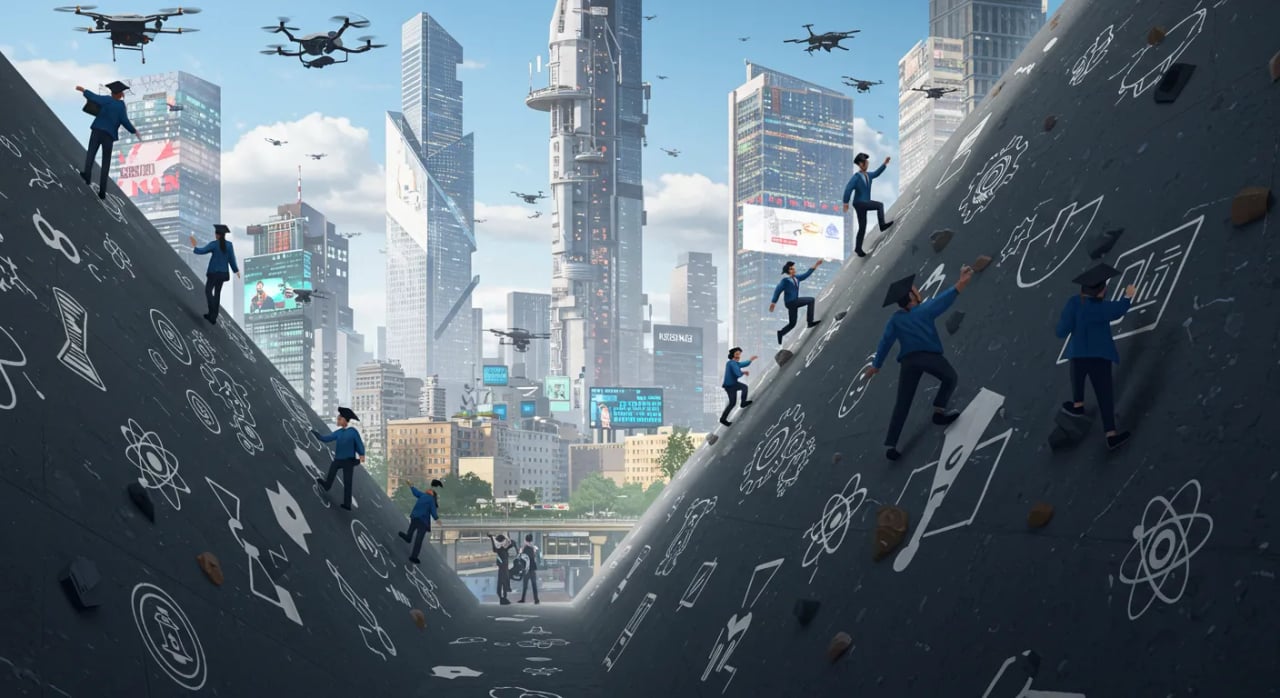
The reality is clear: the job market for recent college graduates is in flux. With a rising unemployment rate and underemployment at 41.2%, you’re facing a landscape where traditional career ladders are being replaced by what feels more like a climbing wall. The skills you develop—and your willingness to adapt—will be critical as you navigate this new world of work.

Career Ladders Are Out, Climbing Walls Are In
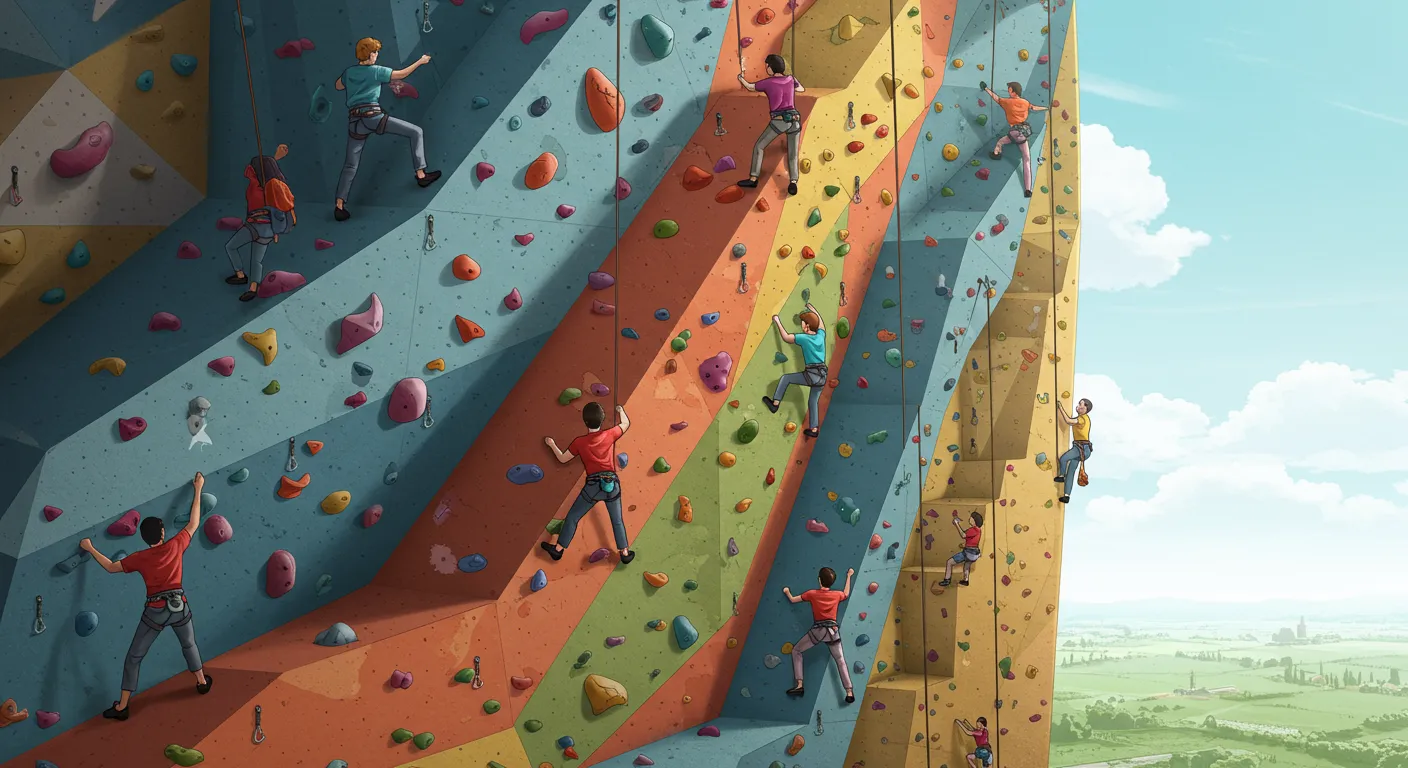
If you’re graduating in 2025, you’re entering a job market that looks nothing like the one your older siblings or parents faced. The classic career ladder—where you start at the bottom and steadily climb up—has been replaced by something far less predictable. Today, the metaphor is a climbing wall: a path that’s agile, nonlinear, and demands constant adaptation. This shift is not just a catchy phrase; it’s a reflection of real job market trends and the new reality of early career mobility.
Recent data shows the unemployment rate for new college graduates has jumped to 5.8%, the highest since 2021. Underemployment is also on the rise, with over 41% of recent grads working in jobs that don’t require a college degree. At the same time, artificial intelligence is rapidly taking over entry-level tasks—think document review, basic coding, or customer service. As a result, the first rung of the traditional career ladder is breaking, leaving you and your peers searching for new ways to gain traction.
LinkedIn’s Chief Economic Opportunity Officer, Aneesh Raman, describes this as a “perfect storm” for new graduates. In a recent interview, Raman explained that by 2030, 70 percent of skills needed for the average job will have changed. That means the skills needed to succeed are shifting faster than ever. You’re likely to hold twice as many jobs as someone who graduated 15 years ago, often moving sideways or diagonally rather than straight up.
What does this mean for your career mobility? Success is no longer about climbing a single, well-defined ladder. Instead, it’s about sidesteps, pivots, and redefining what “progress” looks like. A college friend who majored in art but now works as a remote UX researcher credits her willingness to “climb sideways” as the key to her success. This kind of flexibility is becoming the norm, not the exception.
Employers are starting to catch on. Companies like KPMG and McFarland’s are giving new hires more complex work, while AI handles routine tasks. Meanwhile, universities and community colleges are updating their programs to teach AI fluency and digital skills, preparing you for roles that didn’t exist a few years ago.
Be a learn it all, not a know it all. – Aneesh Raman
In this new landscape, adaptability, curiosity, and a willingness to learn are your most valuable assets. The career ladder may be gone, but the climbing wall offers new routes—if you’re ready to move in unexpected directions.
Skill Up or Get Sidelined: What Employers and Colleges Are Changing
If you’re graduating in 2025, you’re entering a job market that’s shifting faster than ever before. The AI impact is front and center: routine, entry-level jobs—once your stepping stone—are being automated at a pace that’s hard to ignore. Recent data shows the unemployment rate for new graduates has jumped to 5.8%, the highest since 2021, and much of that pressure comes from technology disruption. Tasks like reporting, document review, and basic clerical work are now handled by AI, shrinking opportunities for those just starting out.
Major employers are responding by raising the bar for work responsibilities at the entry level. Take KPMG, for example. The firm is now giving new grads higher-level tax assignments that used to be reserved for employees with two or three years of experience. Why? Because AI is taking care of the grunt work, freeing up humans for more complex problems. At McFarland’s, a UK law firm, early-career lawyers are trained in contract interpretation instead of just sifting through piles of documents. The message is clear: what you can do with new tools matters more than what you already know.
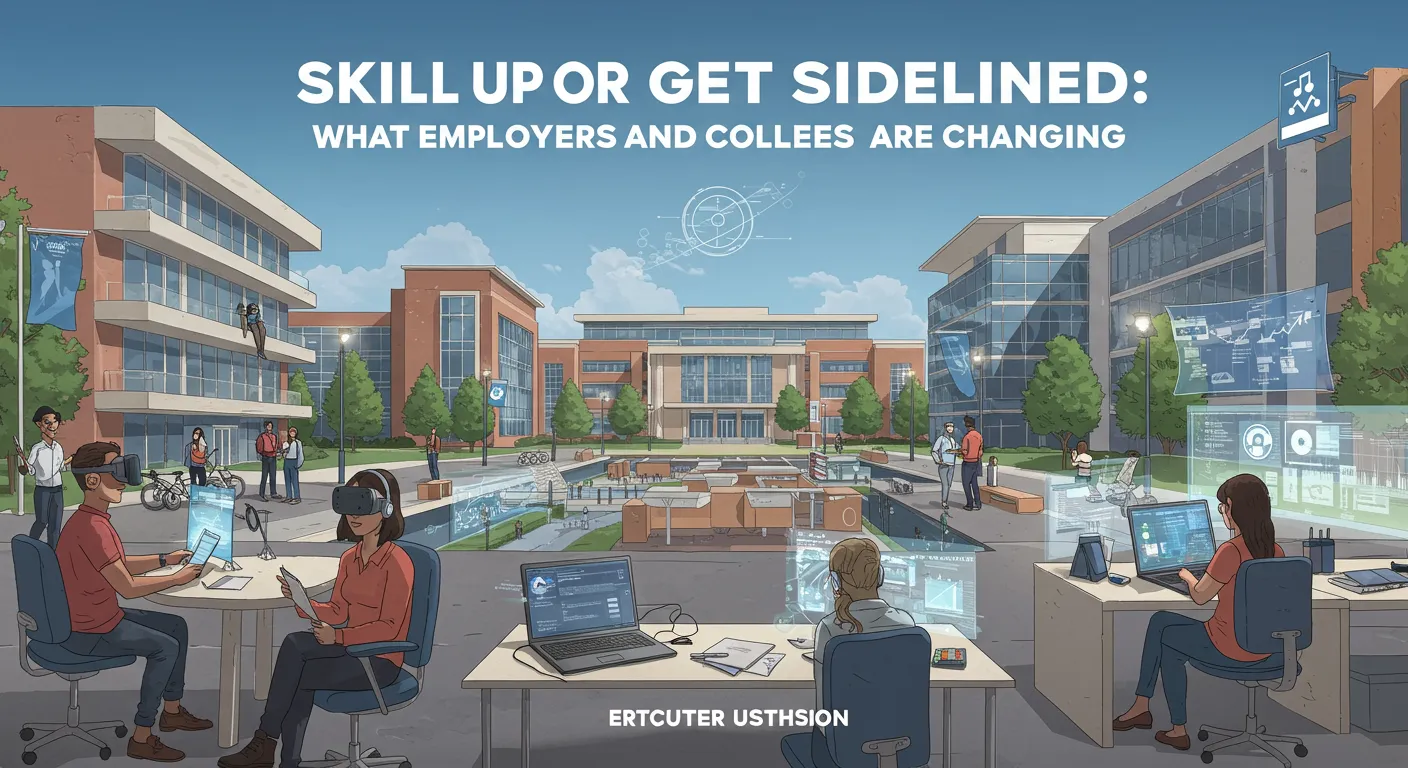
This shift isn’t just happening in the workplace. Colleges and universities are scrambling to keep up, embedding AI fluency and practical tech skills into their courses. American University’s business school in Washington, DC, is rolling out new AI-focused classes, and community colleges nationwide are following suit. The goal? To make sure you have the skills needed to thrive in a world where entry-level jobs demand more initiative, adaptability, and digital know-how than ever before.
Employers now expect you to bring more complexity and initiative to the table from day one. As Aneesh Raman, LinkedIn’s Chief Economic Opportunity Officer, puts it:
Organizations need to deliberately recognize and develop the know-how that new workers bring.
You might hear older colleagues complain about AI “stealing” their busy work, but there’s an upside if you’re willing to step up. With AI handling repetitive tasks, you get the chance to tackle higher-order challenges and grow your expertise faster. But that means you can’t rely on the old playbook. The skills needed now include not just technical know-how, but also the ability to learn new tools, adapt quickly, and solve problems that AI can’t.
Research shows that by 2030, 70% of the skills required for the average job will have changed. The path forward is less about climbing a predictable ladder and more about navigating a “climbing wall”—finding your own route, building new skills, and proving your value in real time.
 Job Search Tactics for a Murky Market: Agency, Learning, and Resilience" />
Job Search Tactics for a Murky Market: Agency, Learning, and Resilience
If you’re a recent college graduate, the job search in 2025 is unlike anything seen in years. The unemployment rate for new grads has jumped to 5.8%, the highest since 2021, and the job market is shifting beneath your feet. AI tools now handle many of the entry-level tasks that once gave young professionals their start. Instead of reviewing documents or handling basic customer service, you may find those duties assigned to machines. This reality is forcing both employers and job seekers to rethink what it means to launch a career.
Forget the old rules about pedigree. Today, employers are less interested in your major or the name of your school. They’re scanning for real-world problem-solving and skills that can’t be easily replaced by technology. As Aneesh Raman, LinkedIn’s Chief Economic Opportunity Officer, puts it, “Curiosity will be your greatest asset.” Recruiters are increasingly using AI-driven resume screening, which means your ability to demonstrate applicable skills matters more than ever. Research shows that skill-based hiring is now more common than at any point before, and the incidence of AI-powered screening is rising across industries.
AI tools aren’t just shaping the work you’ll do—they’re also transforming the job search itself. These platforms can match you with roles you might never have considered, broadening your options in a tight market. You may worry about not landing a job in your chosen field, but adaptability is key. One graduate, after three failed interviews in other sectors, finally found a dream nonprofit role. Each rejection became a lesson, helping refine their approach and uncover new strengths.
Resilience and curiosity are vital as you navigate these job market challenges. The traditional career ladder is being replaced by what Raman calls a “climbing wall”—a path that’s less linear and more about finding your own way. You’ll likely hold more jobs and need to update your skills more often than previous generations. Embrace setbacks as part of the process. Every missed opportunity can offer insight into where you truly fit.
- Focus on demonstrating skills, not just credentials.
- Leverage AI tools to discover unexpected job matches.
- Treat every rejection as a learning opportunity.
- Stay resilient and keep your curiosity alive.
Curiosity will be your greatest asset. – Aneesh Raman
In this evolving landscape, job search itself is a skill. Adaptability, learning from setbacks, and using AI tools are now essential. As recruiters shift away from pedigree, your ability to show real, adaptable skills will set you apart.
Wild Cards and What Comes Next: Imagining the Class of 2025’s Impact
If you’re graduating in 2025, you’re stepping into a job market that looks nothing like the one your older siblings or mentors faced. The old “career ladder” has splintered, replaced by something far less predictable—think of it as a climbing wall, full of unexpected handholds and sideways moves. Maybe you dreamed of finance but landed your first offer in ceramics. That leap sideways could become the twist that defines your story, not a detour but a new route up the wall.
Research shows that early career mobility and adaptability are now more important than ever. With automation and AI shrinking the pool of traditional entry-level jobs, you’re forced to be nimble. The unemployment rate for recent graduates has climbed to 5.8%, and underemployment is at a staggering 41.2%. Yet, this “crisis” could be the start of something bigger—a creative renaissance in how careers are built and how companies think about talent.
Employers are beginning to notice. As AI takes over routine tasks, organizations are reimagining what entry-level work looks like. Some are starting to hire for potential and adaptability, not just technical skills. The future of work may belong to those who can learn, pivot, and grow—qualities your generation is already demonstrating. Imagine a workplace culture obsessed with learning, where your ability to adapt is valued as much as your degree.
Launching your career in 2025 is less like playing chess and more like improvisational jazz. You listen, respond, and riff off new trends. Each job search might feel like building your own video game avatar—leveling up with every “failed” side quest. The setbacks you face aren’t just obstacles; they’re opportunities to build resilience and redefine what career success means for you and your peers.
Looking forward, the struggles of the class of 2025 could spark real change. Your adaptability and willingness to experiment may force entire industries to rethink how they recruit and develop talent. As you navigate this new landscape, remember: the path may be nonlinear, but it’s yours to shape. The future of work is being rewritten by your choices, your creativity, and your ability to turn wild cards into winning hands.
In the end, this moment of uncertainty could be the beginning of a more dynamic, inclusive, and innovative era for career outcomes. The climbing wall is daunting, but it’s also full of possibilities. And you—armed with adaptability and curiosity—are uniquely equipped to scale it.
