
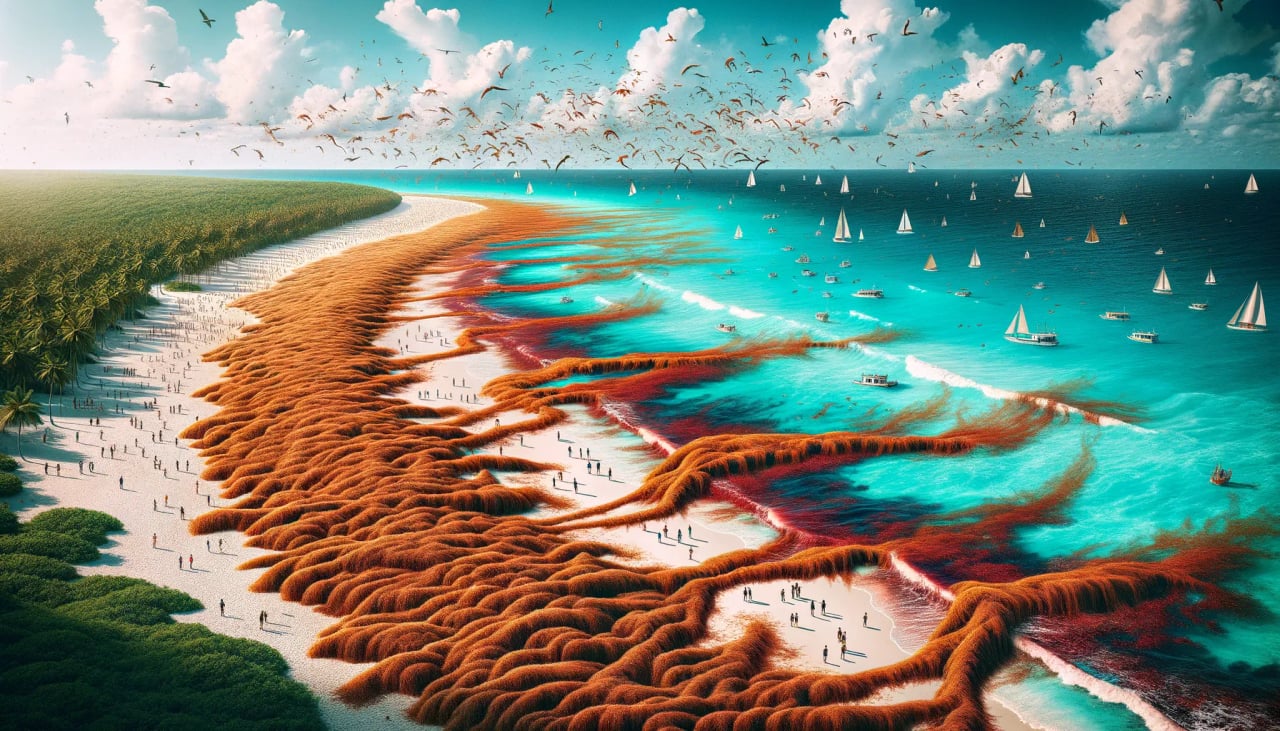



Have you ever started your summer vacation in paradise, only to have a wall of reeking, prickly seaweed block your way to the water? That’s what thousands in the Caribbean faced in May 2025, when sargassum surged like never before. I watched it creep across white sands in Humacao, Puerto Rico, transforming idyllic beaches into post-apocalyptic movie sets. But behind the Instagram-unfriendly images lies a knotty web of science, economics, and human grit—one unfolding disaster at a time.
1. The Summer the Seaweed Ate the Caribbean (Again)
If you spent time anywhere along the Caribbean coastline in May 2025, you witnessed a Sargassum Surge unlike any before. The region saw a record-breaking Sargassum Accumulation —a staggering 38 million metric tons blanketed beaches and coastal waters from Puerto Rico to Guyana, the Gulf of Mexico, and even the eastern Atlantic. This figure, confirmed by researchers like Brian Barnes at the University of South Florida, nearly doubled the previous high of 22 million metric tons set in June 2022. The Environmental Effects were immediate, and the Coastal Impacts were impossible to ignore.
Photos from Humacao, Puerto Rico, taken on June 2, 2025, tell the story in stark detail: piles of brown, prickly seaweed, some taller than beach chairs, stretching as far as the eye can see. This year’s surge didn’t just arrive early—it arrived with a force that caught everyone off guard. Research shows that April-May 2025 saw sargassum concentrations 40% higher than any prior peak, and forecasts suggest the worst may not be over.
The Caribbean Tourism Impact is profound. Sargassum’s arrival suffocates beaches, disrupts local economies, and threatens the region’s most vital industry. As the seaweed rots, it releases toxic gases like ammonia and hydrogen sulfide, forcing temporary closures of schools and businesses, as seen in Martinique. The smell alone can drive residents and tourists away. As French Prime Minister François Bayrou put it:
“The influx disfigures our coasts, prevents swimming and makes life impossible for local residents.”
But the Environmental Effects go deeper. Sargassum mats offshore can support marine life, but once they hit the coast, they block sunlight, smother coral reefs and seagrass beds, and kill wildlife. Birds pick over the stranded creatures as the mats break up, and the decaying piles become a health hazard.
Local responses vary. In Punta Cana, authorities have set up barriers to keep sargassum at bay. St. Maarten’s teams use backhoes to clear beaches after complaints about the smell. The French Caribbean is considering storage barges and specialized vessels to collect tons of seaweed daily, but these solutions are costly and not always feasible for smaller islands. As Frank Comito of the Caribbean Hotel and Tourism Association notes, the distribution is uneven, and not every beach is hit equally hard.
The Sargassum Surge 2025 is part of a cyclical but intensifying pattern. Each year, the volume grows, and the challenges mount. With cleanup efforts straining local resources and the threat to tourism ever-present, the region faces a crisis that is environmental, economic, and deeply personal for those who call the Caribbean home.
2. When Paradise Smells Like Rotten Eggs: The Human Cost of the Sargassum Crisis
Step onto a Caribbean beach in 2025 and you might be greeted by more than turquoise waters and white sand. Instead, you could find yourself surrounded by thick, rotting mats of sargassum seaweed—an environmental crisis that’s rewriting the region’s story. This year, record-breaking sargassum levels have blanketed coastlines from Puerto Rico to Guyana, with scientists confirming a staggering 38 million metric tons across the Atlantic and Caribbean. The environmental effects are immediate and personal: as sargassum decays, it releases ammonia and hydrogen sulfide, filling the air with a stench reminiscent of rotten eggs.
For many, these coastal impacts go far beyond inconvenience. In Martinique, toxic gas levels forced the closure of a local school, highlighting the real health risks. Residents and tourists alike report headaches, breathing problems, and a sense of being trapped indoors. Summer traditions—family picnics, beach outings, and local festivals—are abruptly canceled or moved. As one local hotelier put it, “We have to refund guests or shuttle them to beaches that aren’t buried in seaweed. Some just cancel altogether.”
The economic challenges are just as severe. Caribbean tourism is a $35 billion industry, and when beaches lose their magic, entire island economies teeter. Hotels scramble to clear sargassum from their properties, sometimes offering free rides to unaffected areas or even full refunds. Yet, not every island or beach is hit equally. As Frank Comito of the Caribbean Hotel and Tourism Association explains, “Not every beach gets hit, but for those that do, both locals and tourists can feel trapped.” The impact is patchy—some communities withstand the surge, while others suffer disproportionately.
Research shows that the roots of this crisis are complex. Factors like agricultural runoff, warming ocean temperatures, and shifting currents all play a role. Sargassum, once a vital floating habitat for marine life, becomes a hazard when it piles up onshore. Coral reefs and seagrass beds are smothered, and wildlife is driven away or killed. The environmental effects ripple outward, affecting not just the coastline but the entire ecosystem and economy.
‘For those that live near it, life becomes insufferable.’ – Frank Comito, Caribbean Hotel and Tourism Association
Across the region, responses vary. In the Dominican Republic, barriers are installed to keep sargassum at bay. St. Maarten deploys heavy machinery, while French Caribbean territories consider costly collection vessels . But for many, resource limitations mean that cleanup is slow and incomplete. The sargassum crisis is not just a nuisance—it’s a test of resilience for the Caribbean’s people, environment, and tourism-driven economies.
3. More Than Meets the Eye: Why Sargassum Is Both Villain and (Sometimes) Ally at Sea
In 2025, you’re witnessing a surge of sargassum seaweed across the Caribbean and western Atlantic that’s rewriting the record books. According to scientists, including Brian Barnes from the University of South Florida, the region now faces over 38 million metric tons of sargassum—nearly double the previous peak. This explosion in sargassum species, especially Sargassum natans and Sargassum fluitans , is not just a headline—it’s a daily reality for anyone living near the coast or relying on the sea.
But sargassum’s story is more complicated than it seems. Out in the open ocean, these floating mats are a lifeline for marine ecosystems. The three main sargassum species in the Caribbean— natans , fluitans , and their hybrids—all float thanks to tiny air sacs and reproduce asexually. These drifting oases shelter shrimp, fish, and even endangered sea turtles. As Barnes puts it,
‘Out at sea, sargassum mats form healthy, happy ecosystems.’Here, sargassum seaweed plays a crucial ecological role, supporting biodiversity and acting as a nursery for young marine life.
The trouble starts when these mats, driven by shifting ocean currents and winds, pile up on the shore. Once sargassum hits the coastline, its ecological role flips. Beaches from Puerto Rico to Guyana are now suffocated under thick, rotting piles. The seaweed blocks sunlight, threatening coral reefs and seagrass beds, and as it decomposes, it releases toxic gases like ammonia and hydrogen sulfide. These emissions have forced closures of schools and businesses, and the stench alone is enough to drive away tourists—undermining the Caribbean’s vital tourism industry.
What’s fueling this unprecedented growth? Scientists are still searching for answers. Research shows that factors like agricultural runoff, warming ocean temperatures, and changes in rainfall and wind patterns could all be at play. Barnes and his team at the Optical Oceanography Lab lead efforts to monitor and predict sargassum blooms, but as he admits, it’s far from a perfect science. Each year, the triggers shift, making the phenomenon hard to pin down.
You see the impact everywhere: local governments scrambling to install barriers, hotels hiring cleanup crews, and new technologies being tested to collect or repurpose the seaweed. Yet, resource limitations—especially for smaller islands—make comprehensive solutions elusive. The sargassum crisis is cyclical, with blooms peaking in summer and receding in winter, but each year brings higher volumes and new challenges. As researchers keep hunting for the “smoking gun” behind these seasonal explosions, the balance between sargassum’s role as both ally and villain remains at the heart of the Caribbean’s ongoing struggle.
4. Beach Battles: From High-Tech Barges to Grassroots Grit in the Cleanup War
In 2025, you’re witnessing a relentless Sargassum Surge across the Caribbean, and the battle lines are drawn right at the water’s edge. As the tide brings in wave after wave of sargassum, local responses are as varied as the coastlines themselves. The Dominican Republic, for example, has deployed floating seaweed barriers in Punta Cana, hoping to keep the brown tide from smothering its prized beaches. St. Maarten, meanwhile, has taken a more hands-on approach—dispatching teams with backhoes in late May to scoop up tons of rotting seaweed after complaints about the overwhelming stench of ammonia and hydrogen sulfide.
But these Sargassum Cleanup efforts are not just about brute force or big budgets. In Martinique and other parts of the French Caribbean, officials are weighing the use of storage barges and newly upgraded collection vessels. The hope is to gather and store the seaweed offshore, away from sensitive coastlines. Yet, as French Prime Minister François Bayrou pointed out, even these high-tech solutions come with a hefty price tag and limited reach. “The influx disfigures our coasts, prevents swimming and makes life impossible for local residents,” he said, echoing the frustration felt across the region.
Research shows that while innovation is critical, the reality on the ground is often less glamorous. High-tech collection vessels may sound promising, but as Frank Comito of the Caribbean Hotel and Tourism Association notes,
“High-tech collection vessels are massively expensive.”For many smaller islands, the cost is simply out of reach. Even when money is available, there are environmental trade-offs. Heavy machinery can threaten sea turtle nests and disrupt fragile dune ecosystems, creating new Coastal Impacts even as they try to solve the old ones.
So, much of the Sargassum Cleanup falls to local hotels and resorts. Staff sweep beaches at dawn, sometimes several times a day. When the seaweed wins, some hotels get creative—offering guests perks, refunds, or shuttles to unaffected beaches. It’s a Sisyphean task, and yet, for tourism-dependent communities, there’s little choice. Studies indicate that the Sargassum Surge 2025 is not just an eyesore; it’s an economic threat, with record-breaking volumes—38 million metric tons—blanketing the region and forecasts predicting even more in the months ahead.
As you look across the Caribbean, you see a patchwork of local responses, each shaped by resources, geography, and necessity. The fight is ongoing, and the solutions—whether high-tech or grassroots—are a testament to the region’s resilience and ingenuity. But with each new tide, the challenge grows, and so does the urgency for effective, sustainable Sargassum Cleanup strategies.
5. The Sargassum Forecast : What’s Next, and Can You Really Plan a Beach Holiday Anymore?
In 2025, the Sargassum Forecast is making headlines across the Caribbean and beyond. You’ve seen the images—beaches from Puerto Rico to Guyana blanketed in thick, brown sargassum seaweed, a sight that’s become all too familiar. This year, scientists recorded a staggering 38 million metric tons of sargassum seaweed across the region, shattering previous records and setting a new, troubling benchmark for environmental challenges in the Caribbean.
Official forecasts warn that the surge is far from over. Sargassum growth is expected to continue through June, with a peak likely in late summer. As Brian Barnes, assistant research professor at the University of South Florida, puts it,
“Every year is a record year now.”That’s the reality you’re facing: each season brings more sargassum, and the numbers keep climbing.
But here’s the catch—no one can tell you exactly where or when the next wave will hit. Scientists are still working to understand the complex mix of factors fueling this explosion, from warming ocean waters to agricultural runoff and shifting currents. Even with satellite imagery and advanced models, the Sargassum Forecast remains unpredictable. One island may be overwhelmed while a neighboring shore stays clear, making it nearly impossible to guarantee a sargassum-free beach holiday.
For travelers and hotels, this uncertainty has changed the game. You now rely on real-time satellite maps, social media updates, and the age-old advice to “ask a local” before booking. Some resorts are offering refunds or shuttles to unaffected beaches, but flexibility is now as essential as sunscreen in your travel kit. The message is clear: expect the unexpected, and don’t count on last year’s experience to predict this year’s conditions.
The environmental and economic stakes are high. Sargassum seaweed doesn’t just disrupt your vacation plans—it threatens marine life, coral reefs, and the livelihoods of communities that depend on Caribbean tourism. Cleanup efforts are costly and logistically challenging, especially for smaller islands with limited resources. As research shows, mitigation is struggling to keep pace with the relentless growth of sargassum mats.
So, can you really plan a beach holiday anymore? The honest answer: not with the certainty you once enjoyed. The rise of sargassum seaweed is shaping up to be the new normal for the Caribbean. If you’re heading south, adaptability is your best friend. Keep an eye on the latest Sargassum Forecast, stay in touch with local contacts, and remember—sometimes, the only thing predictable about nature is its unpredictability.
